

TL;DR
Early warning systems help manage strategic initiatives and improve their chances of success. They identify and measure the status of Critical Success Factors (CSFs) and Critical Assumptions (CAs), enabling stakeholders to take corrective action when necessary. An early warning system provides many benefits, including enhanced strategic agility, support for proactive management, and improved organizational communication and alignment.
The rise of generative AI and other intelligent machines has created a lot of turbulence in the business environment as business leaders, investors, regulators, and many other groups scramble to understand how these technologies will impact them.
Previous articles in this series have described methods for developing and executing strategies in such environments, but one important method remains: early warning systems.
Companies can use strategic experiments and real options to manage risk and uncertainty while discerning a path forward, but once strategic commitments are made, executives need early warning systems to ensure these strategic initiatives stay on course, adapt effectively to prospective problems, or are terminated or scoped down before too much time, money, and effort are wasted once things critical to their success go awry.
Constructing an Early Warning System
Figure 1 depicts the process for constructing and operating an early warning system (EWS).

Identify CSFs / CAs
Critical Success Factors (CSFs) and Critical Assumptions (CAs) create the foundation for effective early warning systems.
Critical Success Factors (CSFs) are things within a company’s control that are critical to the success of a strategic initiative (or any other project/program). For example, for an automaker building its first all-electric SUV, CSFs might include:
designing a vehicle with a best-in-class operating range,
creating a design that is innovative but reflects the brand’s established “look”, and
developing/executing an effective marketing campaign to drive demand.
Critical Assumptions (CAs) are things beyond a company’s control but upon which the success of a strategic initiative depends. Returning to the automaker example, CAs might include:
continuing cost and efficiency improvements in battery technology,
continued strong demand for EVs, especially in the SUV category, and
continued strong regulatory support for EVs.
Effective CSFs and CAs can be identified through collective experience, analytic rigor (including machine learning techniques such as Principal Component Analysis), and creativity.
Identify Metrics
Once all CSFs and CAs have been identified, metrics for each must be identified, along with the desired measurement frequency. When possible, baseline measures should be taken.
Returning to the EV example, the following metrics might be identified (these single examples are not meant to be exhaustive):
CSF: Design a vehicle with a best-in-class operating range
Battery Efficiency: The energy efficiency of the battery system. Higher efficiency contributes to a more extended range.
CA: Continued strong regulatory support for EVs
Value of EV Incentives/Subsidies Per Buyer: The total value of government incentives, subsidies, and rebates available for EV buyers (those for manufacturers would be a separate metric).
Agree on Thresholds for Action-Taking
Once all metrics have been identified and baseline measurements are taken, executives and other stakeholders review each metric and set thresholds for prospective management intervention.
Continuing the example (but limiting it to the CA for brevity’s sake), if the total value of the incentives for buyers in the US is currently $7,500, then a threshold for action-taking might be $5,000, based on market research regarding the impact of the incentives on purchase behavior. (Separate measures and thresholds would have to be taken for each country the company hopes to offer its EV since they differ.)
To the extent that different actions might be taken if the incentives rose to $12,000, such a threshold could also be set (thresholds above and below the baseline need only be set if such changes would spur managerial action).
Identify Supporting Actions
Since the CSFs and CAs identified are critical to success, companies should identify and undertake actions to support them. In the case of EV incentives, the company could identify lobbying as one supporting action.
Monitor/Report Status (and Take Action When Necessary)
Once the EWS has been constructed, measures are taken at their defined frequencies and reported to the appropriate stakeholders.
Corrective action should be taken if measures fall above/below previously identified thresholds or if these measures are trending strongly toward these thresholds.
Action-taking is not a step in the operation of the EWS, which is why it appears in a dashed box in Figure 1. An EWS aims to alert management to positive or negative changes that increase or decrease the likelihood that a strategic initiative will achieve its stated goals. Once such alerts have been provided, the EWS’s “work” is done (in each particular instance).
Continuing with the EV example, if the value of incentives falls below the $5,000 threshold value, the company might:
increase its lobbying efforts,
reconsider its pricing,
reexamine its cost structure, or
scope down, scale down, pause, or abandon the initiative.
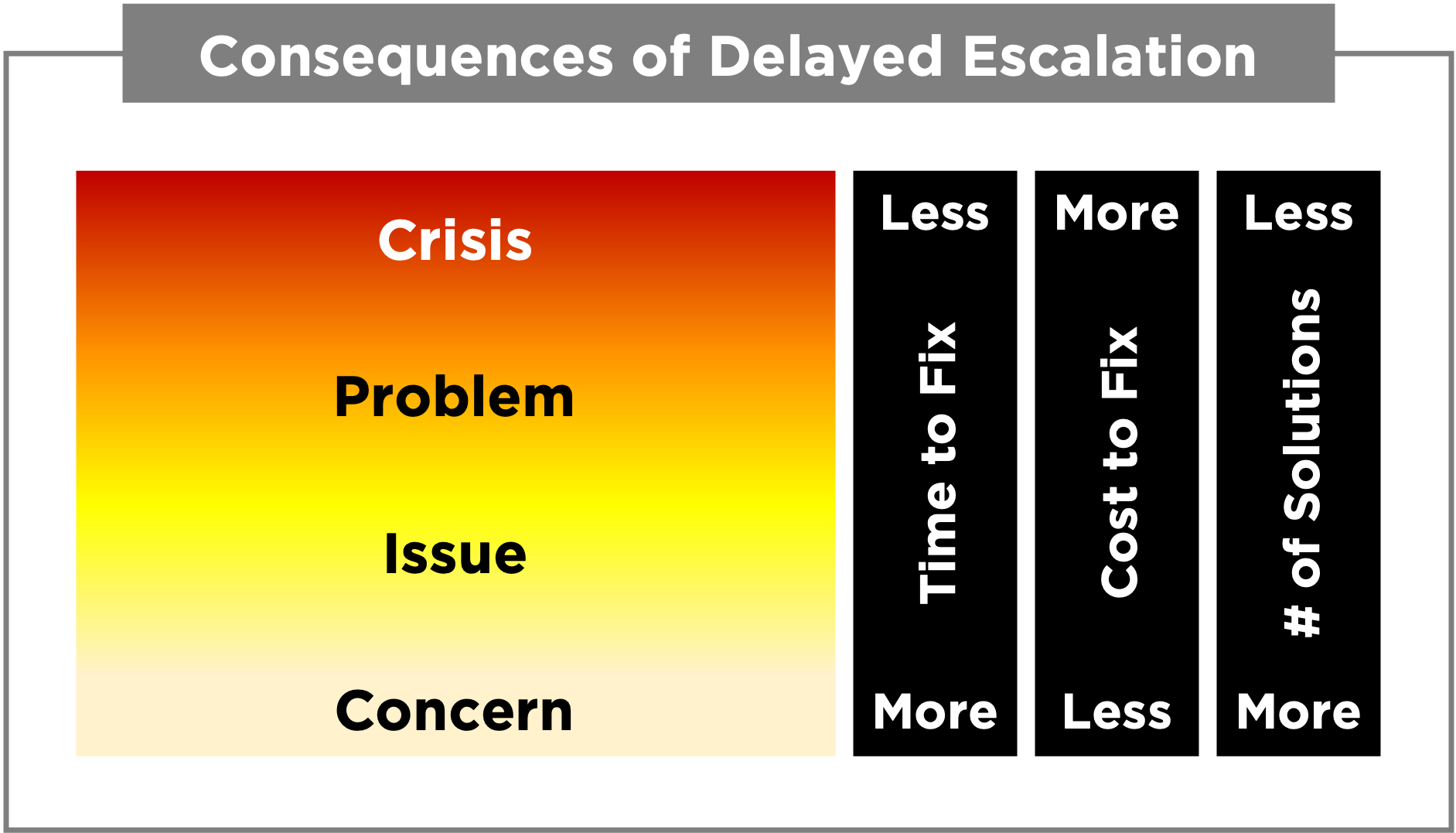
An early warning system is much more valuable in organizations whose culture encourages sharing bad news. We recommend initiating managerial discussions regarding prospective corrective actions when a stakeholder has a concern rather than waiting for it to grow into a problem or a crisis (Figure 2). Such proactive management allows organizations more time to deal with each situation and provides more options (and less costly options) for addressing the situation.
The Case of the Distracted Development Team
One of the first times I created and used an EWS was while helping a large US-based telecommunications provider develop a new advanced technology. Company executives determined that the company did not have the skills, expertise, and experience required to develop the product in-house. They outsourced the development to a team based in Israel.
Since the technology was new, advanced, and complex, one of the CSFs we identified was frequent and high-quality communication between the US-based product owners and the Israeli development team. One of the metrics was the attendance of key development team personnel at twice-per-week design meetings.
Four weeks into the development, these key people began to miss the meetings, sending others (whom they deemed “just as good as me”) in their place. We spoke to them, to no avail. We spoke to the company's CEO and CTO, again to no avail.
After three more weeks of a lack of attendance and responsiveness, we canceled the project. Two months later, the company announced it had been acquired. This initial announcement was followed three months later by an announcement that the division housing the development team was discontinued.
Due to confidentiality restrictions, the company could not tell the telecommunications company why their people were distracted. However, they could have canceled the project themselves (although they would have had to forego a seven-figure monthly development fee).
We pivoted to another outsourced development team that completed the project on schedule.
Benefits of Using an Early Warning System
There are many benefits to using an EWS to help manage strategic initiatives, including the following:
They enhance strategic agility. With a structured process for monitoring the external environment and internal performance, companies can pivot more quickly and effectively when necessary.
They enable proactive management. With current data and trend analyses, stakeholders can make informed decisions sooner by considering the current state and forecasted developments.
They improve organizational communication and alignment. By clearly defining what metrics are being tracked and why, executives ensure everyone is focused on the same priorities and working towards the same goals.