


TL;DR
Typical approaches to strategy development and execution are not well-suited to periods of rapid change, such as those wrought by game-changing technologies such as Generative AI.
If you are concerned that your company’s approach may be deficient, consider adopting an “evergreen” approach to strategic management. Such approaches excel in periods of rapid change and high strategic uncertainty because they produce strategies and implementations that remain relevant, flexible, and sustainable, enabling companies to prosper rather than struggle during such times.
In many large businesses, new strategies are crafted every three to five years (or longer in more slowly changing industries). Once set, they are reviewed annually, but these strategic reviews are more often a budgeting and program management exercise rather than a consideration of what has changed in the business environment and how such changes:
impact the value-creation potential of current strategies and tactics and
create new opportunities or represent emerging threats.
Certainly, business leaders pay attention to such things as competitive moves and changes in customer preferences. And while their companies may respond to such things, the responses tend to be point solutions rather than a reconsideration and adjustment of the business strategy.
This approach may be suitable during relatively calm times in the business environment (although I would argue it is never suitable). It is much less suitable during periods of rapid change, such as those wrought by the introduction of “game-changing” technologies.
Generative AI is a game changer, just as the internet and networked PC were in previous eras. As in the past, business leaders, investors, regulators, and many other constituencies are scrambling to understand how Generative AI and related technologies will impact their worlds.
Do you think your company’s current approach to strategy development and execution can keep pace with the changes being wrought, enabling it to emerge stronger and better than it is today?
My experience says your answer should probably be “No.” In turbulent times, with its attendant uncertainty, your company needs to implement “evergreen” strategic management processes (which also work well during relative calm).
What is an “evergreen” strategy?
I have been using the term “evergreen strategy” internally since 1994 to refer to an approach to strategy development and execution that enables businesses to adapt swiftly, continuously, and effectively to important changes in their business environments, as well as to internal and external information regarding the viability of the company's strategic initiatives.
The goal of this approach is not to react reflexively to every change (which can be a negative side effect of an unhealthy devotion to strategic agility). It is to use what is happening in the business environment to hone foresight and deepen insights to guide strategic adaptations that improve long-term performance.
I thought “evergreen strategy” was a term of art among business strategists. I was wrong. A search on Amazon produced zero books. A search of several leading business journals produced zero articles.
One search returned a reference to Heineken’s new EverGreen initiative. It’s not an evergreen strategy approach, though it references adaptation. Its goal is “to create long-term value for all stakeholders—including the planet itself.”
Marketers use the term “evergreen content strategy” to refer to the “strategy” of keeping content “fresh.” Some entrepreneurs use it to refer to the “strategy” of building a company and never taking it public.
Several books and articles define methods for making a company more agile, such as John Kotter’s “dual operating system” business and Stephen Haeckel’s “sense-and-respond” organization. Without getting into the details, this is not what I mean when I use the term “evergreen strategy.”
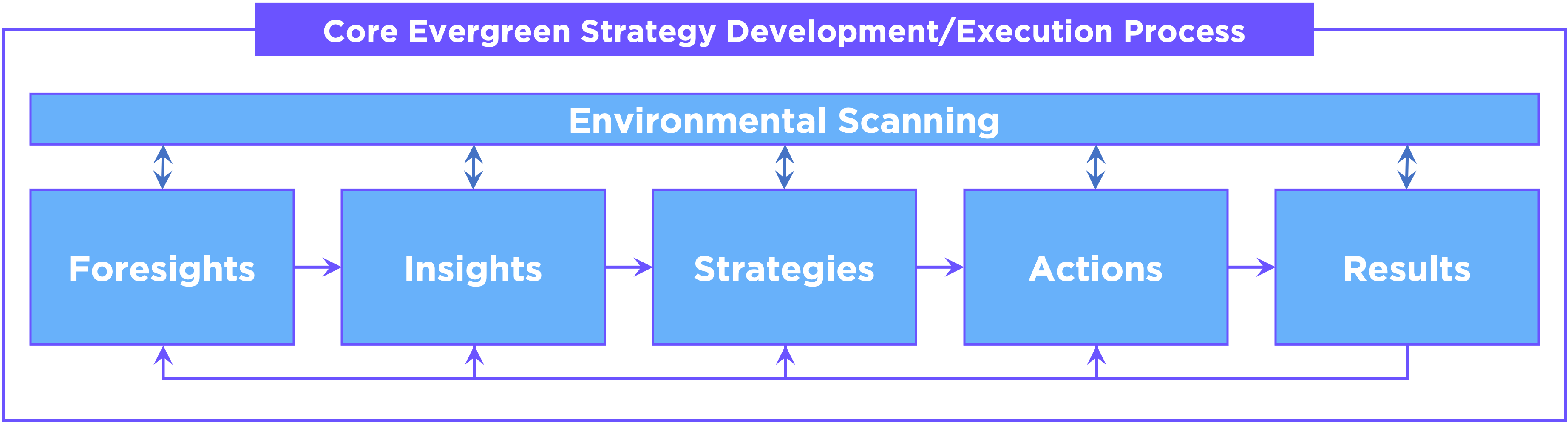
Figure 1 provides a high-level overview of our core evergreen strategy development and execution process (supporting processes, such as change management and financial/risk management, have been removed to focus on the core process). The accompanying text is admittedly brief (given the breadth and depth of the concepts) and may make more sense to me than it does to you. If you want me to clarify or expand on anything, please pose a question in the comments.
The Process
Please keep the following in mind when reviewing the process above:
Companies using an evergreen process do not continually adapt their mission or strategic intent. They implement strategic management processes that improve their chances of fulfilling their missions or realizing their strategic intentions by continually adapting their worldviews, strategies, and actions based on several feedback loops.
While not obvious, the process incorporates a double-loop learning mechanism. Companies using this approach generate new foresight/insight and examine the effectiveness of their current strategies and actions (by examining the attendant results and other data), then, if warranted, change their assumptions about the future and adjust their strategic worldview, resulting in strategic adaptations.
This process is iterative, overall, and at each step. For example, when using new insights to formulate a new strategy, new questions may emerge, requiring additional foresight or new insights, so the process backtracks as necessary to ensure that as much information as is practical is available at each step.
Environmental scanning never stops, though what is being scanned changes at each step in the process. The scans seek information about what is happening outside and inside the company.
Foresight
Foresight work has two components. The goal of the first component is to develop awareness of pending changes in the environment before others. The goal of the second is to develop a deeper understanding of the implications of these pending changes to optimize strategic decision-making.
The first component of foresight work traditionally focuses on identifying weak signals, emerging trends, and prospective events that could affect the company (positively or negatively) in the future.
In many organizations, the second component of foresight work is often overlooked or given much less emphasis than the first. Once something is “seen,” companies consider whether to craft a response and, if so, begin fleshing out prospective responses.
Having considered the first-order effects, they often fail to consider second- and third-order effects, or what French economist Claude-Frédéric Bastiat termed “the unseen.” Bastiat argued that an exclusive focus on the “seen” often leads to suboptimal decisions, and better decisions result from the ability to “foresee” these other effects.
Insight
Companies must use their foresight to develop insights into how these first- and second-order effects could impact their business or industry segment.
One way to develop deeper insight is to attempt to determine what, if anything, will be rendered obsolete, untenable, or no longer true in the future if such a change materializes. This technique, which Nassim Nicholas Taleb termed “subtractive empiricism” in his book Antifragile, seeks a more accurate understanding of the future.
Strategy Development
If the foresight and insights generated reduce uncertainty to the point that a clear strategy emerges, the company can develop an implementation plan.
If, despite the foresight and insight work, a high degree of strategic uncertainty remains (or there is disagreement among the executive team regarding assumptions about the future), then the company can develop a “robust” strategy (see below) or design and execute a series of strategic experiments that can be managed as a portfolio of real options, many of which can be identified by developing a “contingent road map” built by stringing together key uncertainties.
Robust Strategy Interlude
Robust strategies are built on scenario analysis. When well-developed, they often enable companies to prosper to varying degrees regardless of how the future unfolds.
During a previous game-changing technology era (internet/e-commerce), a market-leading software provider was uncertain how quickly e-commerce platforms would be adopted in the industry segments it served. They were also uncertain whether its largest segment would undergo rapid consolidation (unrelated to the emergence of e-commerce) (Figure 2).
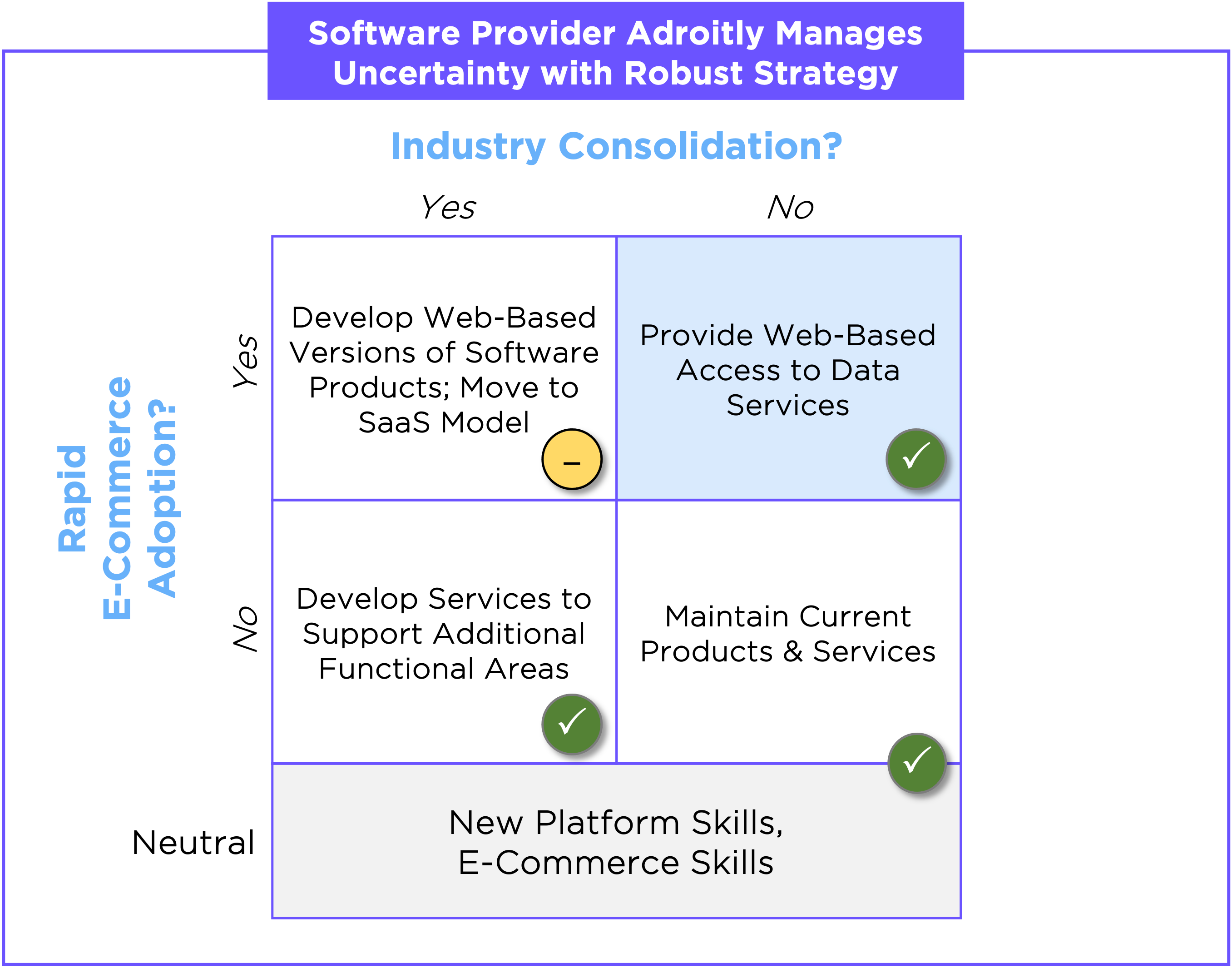
These two uncertainties led to the development of four scenarios. The company identified strategic moves that would position them for success in each scenario. In addition, they identified other initiatives that made sense for them independent of the scenarios (these “no regrets moves” are a staple of robust strategies).
Rapid e-commerce adoption; industry consolidation. In this scenario, the company determined it would have to move to a SaaS model to eliminate the risk of lost revenue due to multiple software licenses in the consolidated enterprises.
Rapid e-commerce adoption; no industry consolidation. In this scenario, the company determined it could continue with its traditional software product offering, but all new services, such as an industry data subscription service, should be web-based.
No rapid e-commerce adoption; industry consolidation. In this scenario, the company determined it would need a new portfolio of services because consolidation would limit growth opportunities in its core product market. The company knew the web and e-commerce were the future, so all new services were web-based.
No rapid e-commerce adoption; no industry consolidation. In this scenario, a lot would stay the same, so the company could maintain its current product/service portfolio.
Outcome-Independent (Neutral) Moves. Regardless of the two key uncertainties, the company knew it had to develop its e-commerce skills and begin developing e-commerce platforms.
As the company moved forward, Scenario 2 was realized. The rapid adoption of e-commerce fueled the rapid growth of the company’s new web-based data (Scenario 2) and support services (Scenario 3), which enabled their investments in platform and e-commerce skills to pay off quickly (Neutral).
Although there was no immediate need to move to a SaaS model for its core products (Scenario 1), this move was made eventually to reduce the distribution, maintenance, and support costs related to desktop software. Because the company’s customers were already consuming its other web-based services, this transition was made easier, quicker, and less costly.
By developing and executing a robust strategy, the company was able to meet its revenue growth goals despite a high degree of strategic uncertainty.
Strategy Execution (Actions and Results)
Taken together, the set of actions that implement a strategy (or set of strategies) will be comprised of some combination of:
neutral moves (deemed valuable regardless of future outcomes),
sustaining/developmental actions (continuation or expansion of existing strategies),
strategic experiments (learning options designed to reduce strategic uncertainty),
real options (investments with asymmetric payoffs—limited downside risk, “unlimited” opportunity—that can be exercised if the future evolves in beneficial ways), and
strategic commitments (significant investments of capital or other resources—that may not pay off—made to establish early leadership in an expected future environment).
As these actions progress, the company should monitor initial results and findings (additional insights based on the experience gained by undertaking the action) and make course corrections as required or implied by the data. In addition, it should gather and assess data related to the set of critical assumptions (changes in the environment beyond a company’s control) and critical success factors (important contributors to success within a company’s control) upon which the strategy’s success depends.
Navigating a path to success in any situation requires a management system that provides early indications that assumptions are proving to be valid/invalid and critical initiatives are on/off track so that executives can make appropriate course corrections when necessary. This requirement is essential during periods of rapid change or high uncertainty.
Why is an evergreen strategy process superior to traditional methods?
An evergreen approach performs better in any strategic environment. It is especially well-suited to developing and executing strategies during periods of high uncertainty, such as what businesses face today.
Developing and maintaining an evergreen strategy enables those strategies to remain:
Relevant (always aligned with current market realities),
Flexible (can pivot swiftly and effectively in response to changing business environments), and
Sustainable (provides long-term success by continually adapting to the evolving business environment).
Adopting such a process will enable your company to thrive in any business environment.