


This series focuses on Collaborative Intelligence technologies, techniques, and their business applications. A comprehensive search for weak signals requires a much broader scope, such as that defined by the popular PESTLE framework.
The arrival of LLMs such as ChatGPT caught most businesses off guard. Organizations are now scrambling to figure out how to benefit from generative AI technologies and respond effectively to the threats they pose to their existing business models.
Some companies, such as educational platform provider Chegg (CHGG), have been hit hard. On May 2, 2023, they suspended guidance due to the unknown impact of ChatGPT on their revenues. Their stock price dropped 51.6% that day. At the time of this writing, it is down 60.6% YTD.
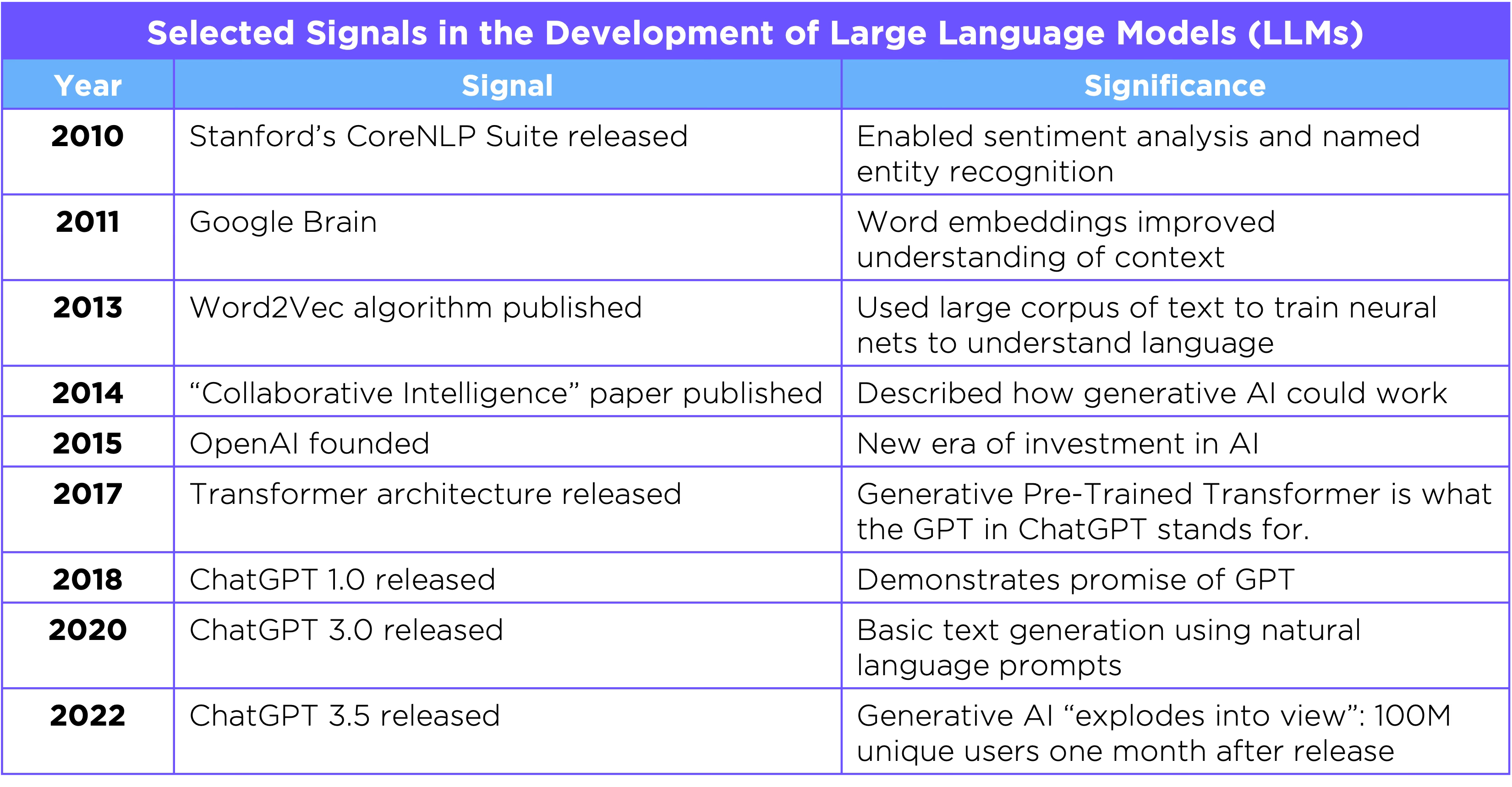
Generative AI is the most recent example of a technology that “explodes into view,” in the words of Ray Kurzweil.
All the companies now scrambling to respond to its arrival could have known Generative AI was coming. There were many “weak signals” that grew stronger over the years (Table 1). But they were not looking for them.
”Strategic surprises,” such as the arrival of generative AI, are not new. They go back at least as far as Ancient Greece and the Trojan War (1194 BC – 1184 BC), during which the well-known Trojan Horse ploy was used. However, looking for and planning for such surprises was limited mostly to military strategy until the advent of formal strategic management processes in the 1960s.
In 1975, motivated by the failure of strategic management to anticipate and respond effectively to ”surprises” such as the widespread market effects of the transistor, the 1973 Oil Embargo, and “stagflation” in the US economy, H. Igor Ansoff, one of the fathers of strategic management, devised a process for reducing the likelihood and impact of these surprises. The key was identifying and tracking “weak signals,” a term he coined.
Though the concept has been around for nearly 50 years, and it continues to be an area of active academic research, most organizations do not have a process for sensing, tracking, and responding effectively to the prospective changes presaged by weak signals.
Until they develop this capability, they risk being caught off guard by technological (and many other types of) developments in their environments, raising the probability and magnitude of negative outcomes and reducing the value of prospective opportunities.
Generic Weak Signals Management Process
Describing the frameworks, processes, and tools Transformativ uses to help our clients identify, track, and respond to weak signals would take a book, not a few paragraphs. As I wrote, there is a lot of published research in this area, and most of the processes and high-level frameworks have similar constructs, so I will present a generic process (Figure 1).

I am hopeful Figure 1 is self-explanatory. Here are a few points of clarification:
Scanned categories are industry- or sector-specific. While certain demographic or geopolitical developments would impact a broad cross-section of industries, most developments are industry- or sector-specific. For example, the quick-service restaurant sector might track vertical farming developments, but the auto dealership sector would not.
Signal assessments are company-specific and strategy-dependent. For example, if “much higher oil prices in 12 months” was a signal…
an oil producer would see it as an opportunity,
a manufacturer of gas-guzzling SUVs would see it as a threat,
an EV manufacturer would see it as an opportunity, and
a software provider would be indifferent.
Organizations can prepare for a range of outcomes. Even though a specific threat or opportunity has been identified, the course of future developments and their impacts may not yet be known. Therefore, it may be prudent to devise a “robust strategy” that would be viable across a range of outcomes.
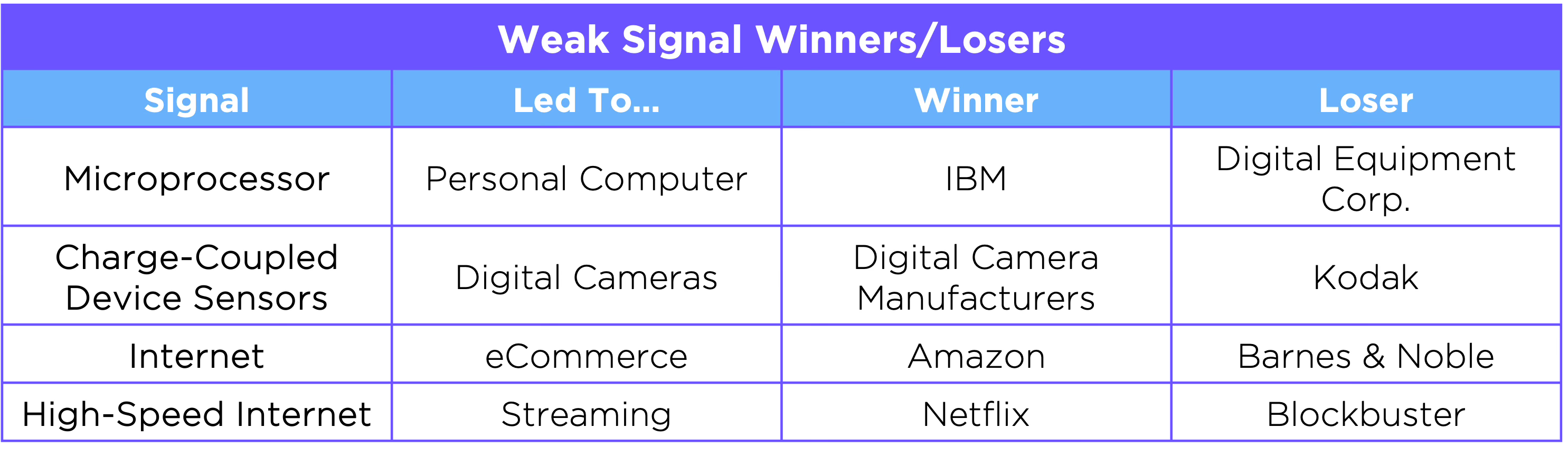
Identifying and responding effectively to weak signals enables organizations to develop and maintain competitive advantages and avoid damaging risks. Despite these benefits, history is replete with examples of companies missing these signals and losing market share to companies that did not. It happens so often that it has a name: creative destruction. Table 2 provides a few well-known examples.
The number and scope of available CI technologies is increasing rapidly, along with their rate of advancement. It is imperative for organizations to manage these many weak signals effectively, so they can prepare for and respond adroitly to prospective impacts.