

As I wrote previously, when speaking with company executives regarding how best to use Collaborative Intelligence (CI) to improve their company’s performance, I ask seven clarifying questions, the second of which is: “There are five areas of focus when designing CI-enabled work. What will be your organization’s primary focus?”
I ask this question so that I can describe each option. Typically, an executive (or executive team) has considered only one or two, and the ones they are considering may not be the best given their strategic rationale for embracing CI. (Understanding their strategic rationale is the purpose of the first clarifying question.)
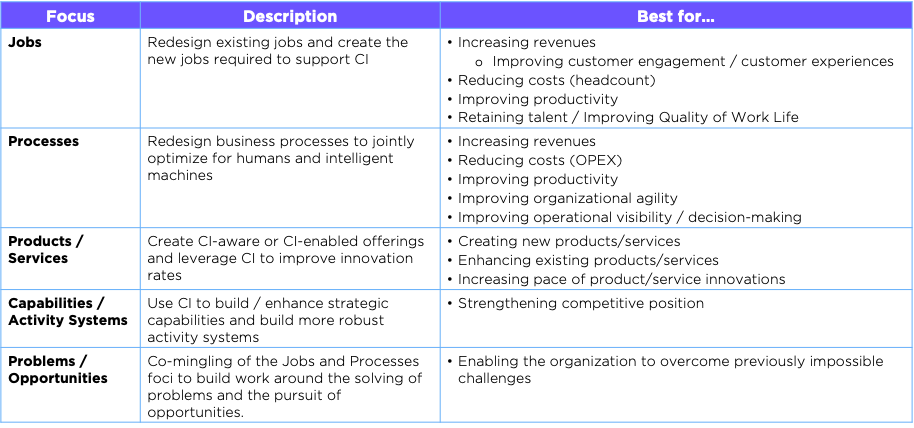
The table below briefly describes the five focus areas and presents a list of strategic goals that are best achieved using each focus.
Keep the following points in mind when reviewing the table:
The focus areas progress from most to least obvious (based on my discussions with executives).
There are no distinct boundaries between the focus areas, so a company could use more than one focus to achieve a specific goal.
The primary focus area may change when the strategic initiative changes (e.g., a company can adopt a Jobs focus when retaining talent and a Process focus when improving organizational agility).
Subsequent articles in this series will provide more detail on how to proceed once a focus is selected and how to achieve the goals listed in each focus area.
When adopting a Job focus, a company examines:
all activities (at the task level) that consume the working hours of the people holding each job or job category that is in scope,
all work products produced by these activities,
all data/information the job produces and consumes, and
all key decisions made by the jobholder.
When adopting a Process focus, a company examines:
each process that is in scope, using a Work Breakdown Structure or other means to identify all tasks required for its completion,
all process inputs and outputs, and
all in-process decisions.
When adopting a Product/Service focus, a company examines:
all product and service offerings,
all internal services provided within and across departmental boundaries (such as an IT service desk for employees who use internal systems),
all product/service development processes, and
all innovation management processes.
For readers familiar with the “Value Stream” concept, the Process and Product/Service foci can be blended to use Collaborative Intelligence to improve customer value and reduce COGS for specific value streams.
Preamble for Capability/Activity System Focus
Business Strategy comprises many camps, each arguing for the best way to develop and execute strategy (see Strategy Safari for a book-length discussion of this problem). The two most prominent approaches in academic and management literature are the Resource-Based View (RBV) and the Activity-Based View (ABV) of the firm.
RBV posits that companies create and sustain competitive advantage by amassing valuable, rare, inimitable, and non-substitutable resources. It is the source of many management concepts, including “core competencies” and “the right to win.”
ABV posits that companies create and sustain competitive advantage by carefully selecting and coordinating activities that create value and incur costs in ways that are superior to competitors. It, too, is the source of many management concepts, including the “value chain” and “lean manufacturing.”
This “battle” represents a false dichotomy. I think a business’ resources comprise its strategic balance sheet, and its activities comprise its strategic income statement. In combination, they determine the strength of a company’s strategic position—just as a company’s actual balance sheet and income statement determine its financial strength. Both must be considered when looking for ways to improve competitive position.
For example, a company’s existing customer base is a resource (or stock in Systems Dynamics parlance). Several activities (or flows in Systems Dynamics parlance) a company performs (such as customer development) determine the rate at which this resource grows or shrinks. Whether it grows or shrinks depends, in part, on how well these activities are performed. Thus, the resources and the activities determine whether specific combinations contribute to or weaken a company’s competitive position.
When adopting a Capability/Activity System focus, a company:
identifies all its strategic resources/capabilities and its activity system,
creates a systems dynamics model linking its key resources to its key activities, and
uses this model to identify valuable leverage points, such that improvements in these areas would strengthen the existing competitive position the most.
This approach is less straightforward than those in the previous focus areas and requires more “art." Still, it can yield more sustainable performance improvements because resources/capabilities and activity systems are much more difficult for competitors to discern and replicate.
Preamble for Problem/Opportunity Focus
The Industrial Revolution led to the widespread focus on business processes comprised of specific and optimized tasks, and responsibility for completing these tasks comprised the definition of specific jobs, most of which were highly specialized. This focus remains predominant today. While the rise of the "knowledge worker" has led to more iterative and open-ended processes (such as those used in Agile software development), such processes are still defined via well-known and well-specified tasks, and such jobs remain highly specialized.
So how does a company proceed when it faces a novel problem or opportunity? It cannot use the building blocks of optimized tasks/processes and specialized jobs because the knowledge and experience required to specify and optimize them don't exist.
It would have to organize work around the achievement of the goal (solving the problem or seizing the opportunity). So why not adopt this more general solution for all work? Such an approach could lead to novel insights, better outcomes, improved agility and adaptability, and a better delineation of work completed via human-machine collaboration.
When adopting a Problem/Opportunity focus, a company must:
clearly define the goal and the measures of success,
“get the whole system in the room” (this phrase was coined by Marvin Weisbord) by forming a multi-disciplinary team that has end-to-end responsibility for achieving the goal (this team may include external stakeholders),
develop a set of hypotheses about how the goal might be achieved,
develop a set of experiments to test the hypotheses,
define the human and digital behaviors required to execute the experiments,
develop/acquire prototypes of the technologies required to create the digital behaviors,
execute the experiments, adapting along the way based on each experiment’s outcome and influence on the measures of success, and, finally,
formalize the learnings into a repeatable process that can be optimized as the company moves along the experience curve.
Obviously, there is a lot to this specific approach. I don’t expect you to understand all the implications from a few bullet points. Future articles (after this series has concluded) will provide more detail on how to implement this approach. Please send me an email or leave a comment if you want me to address something sooner.